A World Heart Day note from BMH Aesthetics, Calicut.
A patient once came in to ask us about the little yellowish patches that had shown up near her eyelids. She wasn’t worried, really — she just wanted them gone before her daughter’s wedding. Fair enough. But those patches are actually something dermatologists and cardiologists both recognise on sight, and it’s not just a cosmetic quirk. It’s called xanthelasma, and it’s often a sign of high cholesterol quietly building up in the blood — the same cholesterol that, left unchecked, ends up clogging arteries around the heart.
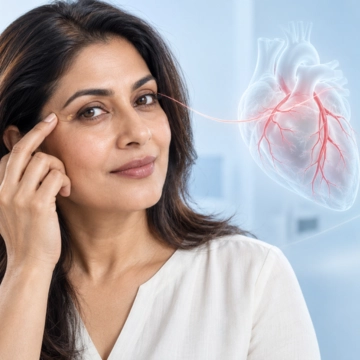
We tell this story not to alarm anyone, but because it says something important: your skin, your hair, even the crease on your earlobe, are sometimes trying to tell you things about your heart long before your heart itself gives you any warning. Most people never hear this, simply because it falls in a strange gap between “aesthetics” and “cardiology” — two fields that rarely talk to each other. But as the aesthetic wing of Baby Memorial Hospital’s Department of Plastic, Aesthetic & Reconstructive Surgery and a trusted Aesthetic clinic Calicut residents can rely on, we happen to sit exactly at that intersection, and this World Heart Day, we thought it was worth sharing what we actually see.
To be clear — none of these signs is a diagnosis. They’re clues. And clues are worth paying attention to.
1. Those yellow patches near your eyes (xanthelasma)
If you’ve noticed soft, yellowish, slightly raised patches forming near the inner corners of your eyelids, that’s xanthelasma — deposits of cholesterol sitting just under the skin. People usually come to us wanting them removed for purely cosmetic reasons, and we understand that completely. But it’s worth knowing that xanthelasma is considered an independent marker for heart disease risk, showing up even in people who otherwise feel completely healthy. If you have this, it’s genuinely worth getting your cholesterol checked, not just the patches treated — and if you do decide to have them removed, it’s the kind of skin concern our team addresses as part of routine dermatological and cosmetic care.
2. A diagonal crease across your earlobe
This one sounds almost too strange to be real, and yet it’s one of the most studied signs on this list. A distinct diagonal line running across the earlobe — doctors call it Frank’s sign, named after the physician who first described it in 1973 — has shown up again and again in research linking it to coronary artery disease. One meta-analysis involving over 30,000 patients found that people with this crease were more than three times as likely to have coronary artery disease as people without it. Nobody fully understands why the ear and the heart are connected this way, though the leading theory is that both share very fine blood vessels that respond the same way to wear and tear over the years. It’s not proof of anything on its own — plenty of people have this crease with a perfectly fine heart — but it’s a genuinely interesting one to know about, especially if it shows up alongside other risk factors. Coincidentally, the ear is also something we work with closely through otoplasty consultations, so it’s often right in front of us.
3. Hair thinning at the crown, earlier than you’d expect
We see a lot of people for hair loss, and understandably, most just want to know how to fix it. But there’s a body of research — including the well-known Copenhagen City Heart Study, which followed people for 35 years — that found early male-pattern baldness, especially at the crown, to be independently associated with a higher risk of coronary heart disease. It doesn’t mean everyone with a receding hairline needs to worry. It means that when our team is consulting with someone about hair restoration, we’re not only thinking about how it looks — we’re also gently nudging people, when it seems relevant, to get their heart health looked at too.
4. Cuts and wounds that take longer than usual to heal
This is one people rarely connect to the heart, but circulation has everything to do with healing. When blood isn’t moving efficiently through the smaller vessels — which can happen with diabetes, high blood pressure, or early cardiovascular disease — even small cuts, blemishes, or post-procedure marks take noticeably longer to fade or close up. It’s actually one of the things our specialists keep an eye on during recovery after any of our procedures, surgical or non-surgical, precisely because healing that’s slower than expected is rarely “just skin” — it’s usually the body flagging something underneath. If you’ve had a minor skin treatment like a chemical peel and found the recovery slower than it should be, or you just notice you bruise and heal more slowly than you used to, it’s a reasonable enough reason to get a general check-up alongside any skin concern.
5. Premature greying, paired with other signs
On its own, grey hair is just grey hair — genetics and age, nothing more. But research has pointed to premature greying, when it appears alongside things like elevated cholesterol or early hair thinning, as part of a broader pattern connected to cardiovascular risk. We mention it here not because grey hair alone should worry anyone, but because it’s one more piece of a puzzle that, taken together with the other signs on this list, is worth paying attention to.
Why we’re the ones telling you this
We’re an aesthetics and plastic surgery practice — we spend our days looking closely at skin, hair, and the small details people want to change or improve about how they look, using the kind of certified specialists and advanced technology our patients trust us for. It puts us in an unusual position: we often notice these signs before anyone else does, simply because people come to us for reasons that have nothing to do with their heart, and we happen to see the clues along the way.
We’re not cardiologists, and we won’t pretend to be. What we can do is tell you, honestly, when something we’re looking at might be worth mentioning to your doctor — and being part of Baby Memorial Hospital means that if you do need to be seen by a cardiologist, that referral is a short walk away, not a search for a whole new hospital. We think that’s a responsibility worth taking seriously, especially on a day built around exactly that idea. In keeping with this year’s World Heart Day theme, “Don’t Miss a Beat,” we view it as a gentle reminder to stay attuned to those subtle physical indicators — and to give them the attention they genuinely deserve.
If any of these signs sound familiar — a patch near your eyes, a crease on your ear, hair thinning earlier than expected — it doesn’t need to become a source of worry. It just needs a conversation, ideally with both a skin specialist and a doctor who can look at your heart health directly. We’re happy to be part of that first step.
To book a consultation at BMH Aesthetics, call +91 8157 822 822 or get in touch online. We’re located within the Department of Plastic, Aesthetic & Reconstructive Surgery, Baby Memorial Hospital, Indira Gandhi Road, Arayidathupalam, Kozhikode.
Frequently Asked Questions
Okay, I have one of these signs. Does that mean I have heart disease?
No. These are risk clues, not a diagnosis. Plenty of people have them with a perfectly healthy heart. Treat it as a nudge to get checked, not a reason to panic.
I’ve got xanthelasma, but my cholesterol came back normal. Can I still get it removed?
Yes. Removing it is purely cosmetic and doesn’t change your heart risk either way.
I noticed a crease on my earlobe. Do I need to rush to a cardiologist?
No rush. Just mention it at your next routine check-up, especially if you also smoke, have high blood pressure, diabetes, or a family history of heart disease.
If I fix my hair loss, does that lower my heart risk too?
No. Hair restoration treats the hair, not whatever caused the thinning. That’s a separate conversation with a doctor.
Will you actually test me for heart disease when I come in for a skin or hair appointment?
No, that’s not our lane. But if we notice something, we’ll say so — and getting you to a cardiologist is easy since we’re part of Baby Memorial Hospital.
My skin healed slower than expected after a procedure. Should I be worried about my heart?
Not automatically. Slow healing can come from age, diet, or smoking too. If it keeps happening, it’s worth a check-up.
I’m young with no family history of heart problems. Is any of this even relevant to me?
Yes. The research behind these signs holds up even in younger people without a family history. Awareness costs nothing.